Beyond What We Currently Know?

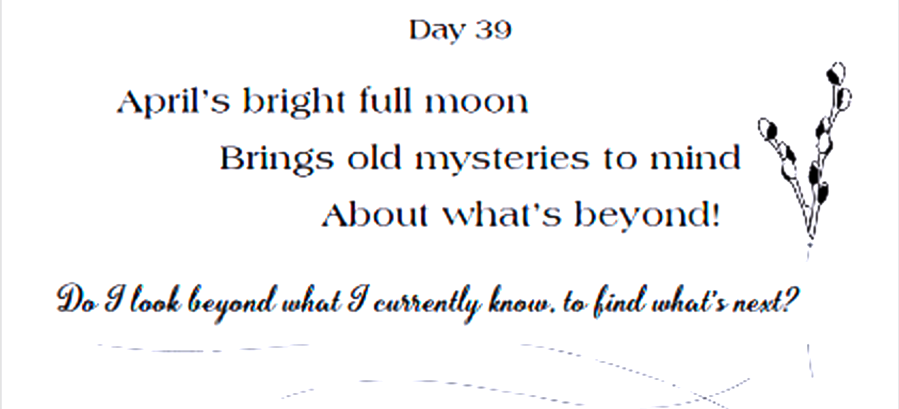
First, before anyone can ask, I did notice that this haiku, having been written on the 39th day of Spring in 2021, does not exactly describe last night’s moon.
Often when I look at the moon—in any of her phases: full or not, waxing or waning, hidden or showing off—I am taken by the possibility of what lies beyond her luminous face. What exists behind her profound darkness?
Today, when I read this poem and the reflection I wrote in 2021, and I was drawn toward another “beyond” that weighs heavily on me these days: What will we have to build on when the resistance works? What will we do when “we, the people” face whatever is beyond that? Will we fall back on what we know only from our recent past? What will we have the courage to forge out of the possibility of the future?
I have heard a few writers touch on this topic in the last few days. And there are only a few who are even bothering to ask the question. Yet, we must start thinking of that today, or we run the risk of simply re-creating what we had: a democracy that granted privilege and wealth. A democracy where the power lived in the hands of a few, and was kept from many. It’s the democracy that grew out of the social structure and culture of the late 18th century. While our world still needs strong democracies, we have far outgrown the social and political realities of that particular time.
We have an opportunity to live out the true intent of the Constitution in today’s landscape. But what will that look like? How will we get from where we are today to wherever it is that shift will take us?
I think I know what won’t get us there! I don’t believe it will work if we go back to living a newer version of a social structure created by a handful of privileged, educated, rich, white landowners in the 1700s. This is not intended as a slam at our “founding fathers”, but we no longer live in that world. “We the people” cannot simply look for someone else take up the reins and make the decisions.
As a person who is trained to support others in times of complex change, I really don’t know what that will take. And I don’t believe anyone does. I do, however, believe it will require that we begin to consider that question now—and to consider it in coffee shops, and around kitchen tables, and in our schools, in our Substack, BlueSky, and other social media posts, and in our meetings as we plan for the next actions of resistance.
It will only work for us if “we the people” embrace our roles as citizens of a nation that is governed by the will of its citizens. It will only work for us if we embrace our questions, rather than looking to past expertise.
What are questions we need to ask? Here are a few that keep bouncing around in my head:
•How do we build a level of national consensus—or a common cause—when the divisions are currently so great in this country?
•How do the Constitution’s directives for a democratic government get translated to create a set of instructions to help us understand how to be citizens who form and live inside that democratic government?
•How do we continue to shape our resistance in ways that form a foundation for a true and functioning democratic society?
I have more questions—some I can’t even put into words yet. What are some of your questions about this, as you “look beyond” what you currently know?
I’d love to hear your thoughts. Comment below or join a conversation thread.

Brilliant Royce! I love your questions you’ve posed at the end. We can’t go back to what we had, and I don’t think any of us know what a better way looks like yet. But together we can inquire and act, and inquire and do it with care - and perhaps the possibilities will become more clear. Thanks!